Tuesday, June 30, 2015

Perfecting the Visual Schedule-Object Schedule

Visual Schedules run my classroom; as they should in any autism classroom.  Visual Schedules provide our students with knowledge of what their day looks like including instruction, breaks, lunch, recess, etc.
We differentiate our instruction based on an individuals need, but are we differentiating our students' schedules?

Object Schedule
Use the object schedule for the student who is still learning basic noun identification.  Think of someone with a mental age of 6 months-18/24 months.  Find miniature objects which closely resemble the actual item.  For example, for snack time, have an empty cup; bathroom, have a small toilet; library, a small book.  Place velcro on the back of the item and hang on a schedule (include the students picture and a mirror), students then take the item off of their schedule and use the object as a transition item to take to the desired location; at the location have a place for the student to match the object (object:object or object:picture).  During your 1:1 instruction time with the student begin to develop the skill of matching the object to a real picture.  Once they student has mastered the skill of matching object to a real picture, it is time to transition the student to a real picture schedule.

Check back soon for other forms of the visual schedule.  

Thursday, March 5, 2015

Mind the Gap - Student Work

The Mind the Gap intervention has been going well.  The students understand how to map it out.  As I had mentioned previously we began with very basic choices: Do I want to eat Carrots or Ice Cream for snack.  Mapping it out: Stop-It is snack time.  Think-If I eat carrots-They are healthy, they digest well, they are crunchy; if I eat ice cream-It is unhealthy, I could get a cavity, It is tasty.  Act-I will eat carrots.  As we expanded we introduced the concept during our social skills group when they were not in a state of acting out or crisis.  Here is a video of a student explaining what to do when he is frustrated:

We then began to implement it during/after moments of crisis.  Here is a student's work before they decided to break a rule.  


We use this almost every day and not always for negative behavior.  We use it quite a bit to teach that everything we do in life is a choice, we have even tied it in to character studies (for our higher level reading students) to map out a characters thinking.

When we use this with a student before, during or after a crisis, we send a copy home to the parents.  Our parents have all been briefed in this intervention and have copies at home to use as well.  

If you are interested in this intervention technique and would like clarification please contact me through the blog.  If you are interested in using this within your classroom, please check out the product available on my TpT store.

Saturday, January 10, 2015

Mind the Gap

Trying to teach students who lack empathy that their actions have consequences is challenging.  I struggle with it; there is a fine line of what and how to teach a child who takes pleasure from hurting others.  My student will give the scripted response that his choice is bad, or that the other person will be "sad" or "hurt;" however he truly does not understand that there is a consequence for him and a consequence for the person whom he has injured.  For example, if he pushes a shelf over onto another student, he understands that it is bad to do and that the other person will be "sad," but he does not understand that he loses privileges and that the other person may break a bone or bleed and not want to be around him.

I am a non-violent crisis intervention trainer, I have a background in behavior, and I have been teaching Autism and Severe behavior for over 8 years.  I keep coming across the "mind the gap" intervention but could never understand how to implement it.  I finally had that lightbulb moment!

Here's the overview:  We are all faced with choices each day and each choice brings us to a metaphorical fork in the road, each route has consequences directly related to the choices that we make.  Example:  I love shoes!  They make me very happy!  I was at the shoe store and I was faced with the choice of whether or not to buy a new pair of shoes (CHOICE).  ROAD A-If I buy the shoes I will not be able to go out for bagels and coffee each morning this week, but I will have new shoes.  ROAD B- If I do not buy the shoes, I will not have new shoes, but I can afford to eat the breakfast of my choosing this week.

Classroom Translation:  We teach our students that they are responsible for their choices and that a choice is either good or bad.  However, we never explain, or map out, what each choice means.  I have begun to implement this with my students, especially with my more aggressive students.  I phrase it in more of an if/then statement, "If you destroy property you lose your break time.  But if you follow directions you earn all of your break time."  I have begun to put this in visual form as well; we must remember that when our students are in their brain-stem thinking they are not comprehending our words, thus visuals are important!

Word of Caution:  You know your students.  I have to be very careful with my one student who enjoys violence and hurting others.  I teach him that his actions have consequences because of his future, not because I want him to be excited that he knows his actions hurt others.  I make sure not to validate that his actions hurt or upset me or others.  I try to keep emotions out of his teaching.

More to come on this later and hopefully a video of how to utilize this strategy!  A product will be up on TpT soon!

Tuesday, December 16, 2014

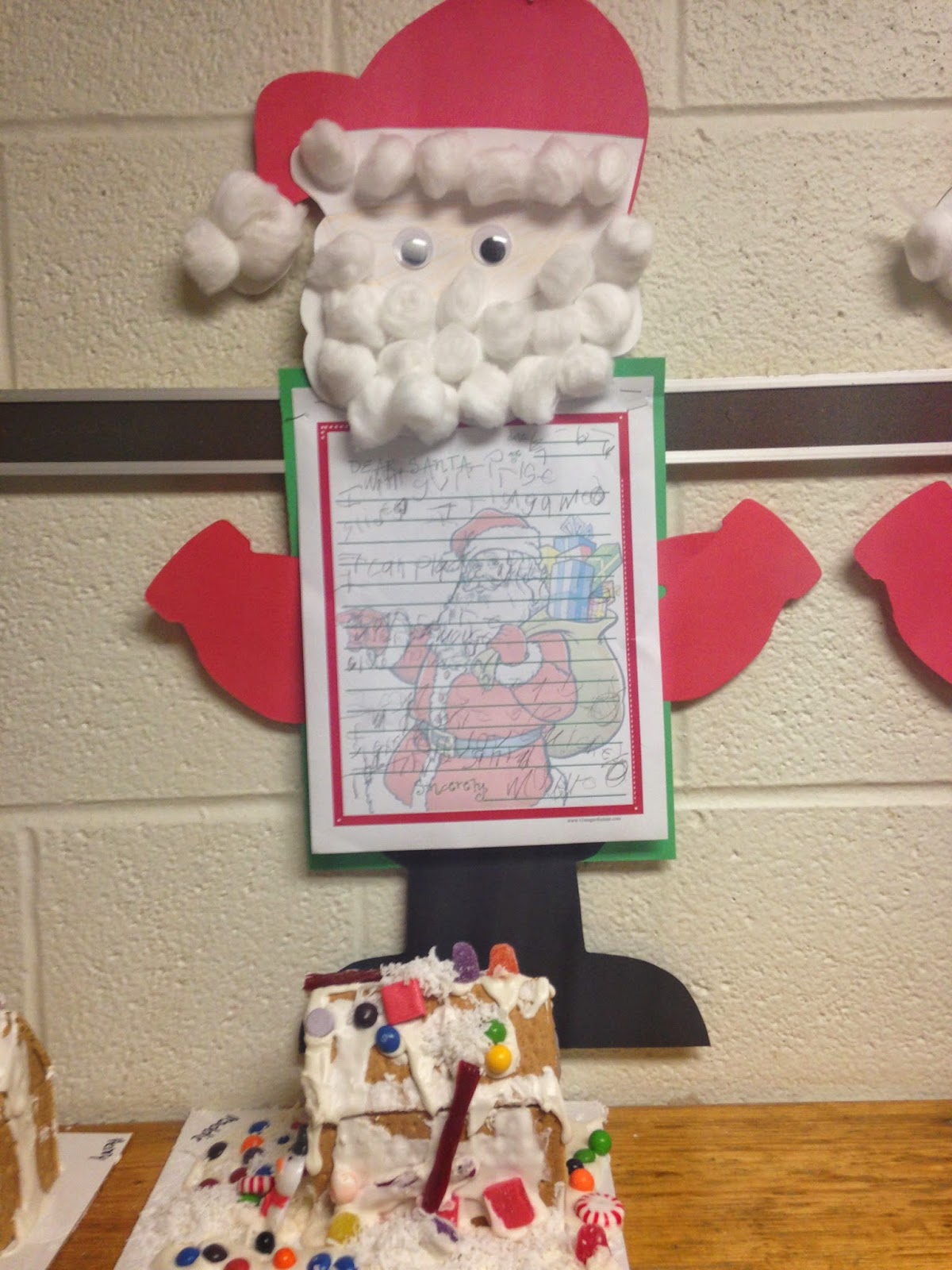
Dear Santa- Winter Handwriting Activity

I will be the first to admit that teaching handwriting is not my strong point.  I've often used the excuse that my students with Autism don't like to write, so we do what we must and get by; it's a technology world anyway.  Don't get me wrong, I do understand the importance of teaching our students with Autism to write, but was this something that you learned in school or just in passing conversation with the OT?

I have, however,  made it my professional goal to find ways to make writing meaningful for my students and to incorporate more writing activities into my students week.  It did not start out with a big project, it started very small, as a transition activity after lunch.  Each student now has a writing binder in which they answer a simple question or fill in the blank and then add a picture.  Now after a few weeks of getting my students desensitized to this, I expanded with this project.


We started with our pre-writing using the basics of Expanding Expression.  My students are familiar with Expanding Expression; we often use it during Language Arts instruction (more blog posts to follow about that).  A few of my kiddos already knew what they wanted for Christmas and were able to verbalize this to us; for those kiddos we found it online, to confirm it is what they wanted, and then printed a picture of the toy so we could help if they ran into difficulty.  For my kiddos that were not able to verbalize what they wanted we pulled out the Toys R Us catalog and went from there.

We did not do all of our pre-writing in one day, it took a few days to complete. Green=Group; Blue=What does it do?; White=What does it look like?; Brown=What is it made of?; White (with triangle)=Where do you get it?; Pink=Details-Why should Santa bring it?; Orange=Anything else/Thank you.

Here is a sample of what it looked like.


Over the next few days we worked on the final product.  The kiddos really seemed to enjoy this product and one student has even wrote another letter to Santa which we have mailed to the North Pole!  I had the Santa paper in a folder, but I'm sure I found it online somewhere.  I also hand made the Santa parts, except the mittens; click here for the sketch: SANTA

And the final product.....


Sunday, November 30, 2014

Cyber Monday

It is that time...Cyber Monday deals on TpT!  Head over for 20% off all products!

Thursday, November 20, 2014

Christmas Freebie


Spreading some Holiday cheer everyone's way with this new freebie!  Teach and review Christmas nouns and verbs with this packet. Head on over to my TPT store for this freebie!  This is a great addition to your independent/TEACCH center!


Tuesday, November 18, 2014

It's the small things that count

We all need a reminder every now and then to celebrate the small accomplishments!  As an Intervention Specialist we not only manage our students, but paraprofessionals, administrators, general education teachers, specials teachers, and parents too.  We need to not only remind ourselves, but everyone around us, to celebrate the small accomplishments that we and our students continue to make.  If we constantly look at the skills that our students lack we will drive our selves mad.  We need to celebrate the small things, like our students responding to a greeting, our most severe ED students spending time in the general education setting (even if it is only a minute longer than what they normally tolerate), a student asking a question, us taking extra data for the day, or getting to eat lunch with a friend.  When we focus on the skill deficits that our students have or the loads of paper work left for us to conquer, we lose sight on what truly matters.  So my positive message that I hope to spread to you...Celebrate the little victories!  Celebrate the little victories with those that you work with and help others feel like they are making a difference in our sometimes difficult and depressing field.  When you celebrate the little victories you begin to see the big picture!

Math Fluency Packet

Here is a new product for math fact fluency.  The packet includes addition and subtraction fact fluency assessments, file folders, data collection sheet, worksheets, and "I can" badges.  I have created the file folders for students to practice +0, +1, +2, +3, etc through +10 and doubles; this is the same for subtraction.  When students complete a fact fluency assessment with 80%+ they receive and "I can" badge which allows them to be proud and show what they know for the fact family which they have mastered!  Head over to my TpT store or Teacher's Notebook to get your copy now!

Tuesday, October 7, 2014

Welcome Back

Welcome back everyone!  This year brings yet another change...I've said good-bye to the building that I have taught at since my first day of teaching, I am now at a new building, teaching first grade Autism and Severe Behavior/ED!  I have actually been back to teaching, but I feel as if I haven't been able to catch my breath.  Now; however, we are making it work and it is getting easier day by day.  Working with 3 new aides and a student teacher, a first and third year general education teacher and a new principal...WOW!

Here is what has helped me survive....
Schedules for EVERYONE! XCEL spreadsheets for adults and Visual Schedules for the kiddos!

Constant Lesson Plans!  Why do I feel like have never lesson-planned to this level before, but at least it helps to keep my head above water! 

CAPS Reports - Comprehensive Autism Planning System

These are a life saver, not only for the staff working with the students, but for the parents to understand what and how their children are learning.  These are great for your parents whose needs are difficult to meet.  The CAPS reports addresses 9 areas: Activity, When it is taught, Target Skills to Teach, Structures and Modifications, Reinforcement, Sensory Activities, Communication/Social Skills, Data Collection, Skill Generalization.  In years past I have used the daily CAPS report; a CAPS report is completed for each day of the week for each student (I try to update each of these once a quarter).  This year I am using the CAPS report by activity; a CAPS report is completed for each student, activities are listed and days the activities are addressed are then highlighted.  The paraprofessionals are able to cross-reference the daily schedule with each students' CAPS report.

Click here to download the CAPS report by activity.


Click here to download the daily CAPS report.


Also, don't forget to check out my TpT store for a new math fact fluency product for addition and subtraction.  The packet includes fluency tests, data sheets, file folders, worksheets and "I can" badges!


Sunday, December 8, 2013

New Product, New Shop


A new product has been uploaded on my TpT store.

About the Product:
Practice following the rules of words ending in -s, -ed, and -ing. 
Word Work Activity
Practice making words
For Regular Ed and Special ED
TEACCH Tasks included


In other news...I finally have a Teachers Notebook Shop!  Swing on over and check it out!  A special sale will be running this Monday through Friday in celebration!

Monday, December 2, 2013

Wednesday, October 9, 2013

Things I learn in Second Grade: Acrostic and Array

I would like to remind you that I know of these things, however did not know it had a name.


According to Wikipedia, "An acrostic is a poem or other form of writing in which the first letter, syllable or word of each line, paragraph or other recurring feature in the text spells out a word or a message."

Here is a sample of an Acrostic Poem:

Siesta Key
Ukulele
Nirvana
No worries
Yes 

An Array is a math term used to define a set of columns/rows. 
Picture borrowed from eisforexplore.blogspot.com


Where was I in school?  How did I not learn the terminology for all of this?

Tuesday, September 24, 2013

Weekly Interventions (for the general education classroom)

1) Self-Implemented Self-Regulation Break
  I have a student that has a difficult time with self-regulation skills.  In addition to implementing the Zone's of Regulation for this student/class, we are giving him a self-implemented self-regulation break.  He has a timer, which is set for 5 minutes, that is attached to the door.  When he feels like he is sad or going to cry, he is able to take the timer and go for a walk/drink/bathroom break.  He always returns on time after his 5 minutes are up and quickly returns back to work in his general education classroom. 


2) Wiggle Cushions!
  Wiggle cushions are a great way to get the wiggles out!  Wiggle cushions are great for students who: need to move during seated instruction, or have poor writing posture.

Friday, September 6, 2013

Weekly Top 3

I took some Nyquil and am not in a focused state of mind.  I can't believe I made it almost 3 weeks before getting sick :)  Hope you all are staying healthy!

1) Thinking Notepad.  Hold that Thought cards may not work for every child.  For example the student that has no impulse control and has the incessant need to share every thought that comes to mind.  In order to satisfy his need to be heard, I placed a small pad of paper on his desk; with this pad of paper he is encouraged to write down his comments and questions.  We then read the paper throughout the day and make time to discuss the comments and questions with him.

2) Aroma Therapy.  Use different aromas to help alert or calm a student.  Use citrusy or minty smells to alert, and smells such as lavender to calm.  Simply place a drop of essential oil or fragrance onto a cotton ball or tissue.


3) Cover the sink!  We have sinks in each and every classroom in our building, while this is beneficial, especially in a preschool classroom, it does create a problem.  I have students who would play in the water for hours if I would let them.  So for a quick and easy fix I grabbed this file box from Walmart for super cheap...And it gets the job done!  You may want to use a solid colored box if this is not enough.

And here is a bonus intervention for the teacher:
DONUTS!  Let's be truthful, it is much easier to come to work on Friday's knowing that there will be donuts!

Thursday, September 5, 2013

Things I learn in second grade: Math

As I mentioned before, I am only in the second general education classroom for 1/2 of my day, and everyday I learn something new.  So do not make fun that I do not have this information in my repertoire, or maybe I do and I just have different terminology for it, or maybe I have been teaching at the preschool level too long; either way, Second graders raise the bar!

This week I have learned:
1) Commutative Property
2) Landmark Numbers
3) String Addition

These things of course make sense to me, and I do use them, but let's be honest...Who actually knew that it was called something?

Tuesday, September 3, 2013

Weekly Top 5

Wait/Hold that Thought Card

1) Hold That Thought Card
     We use this card when students really want to share something, but it is not the time.  During the lesson the teacher/aide will hand the student the card (this can be if they begin to talk or if their hand is raised).  At the end of the lesson, or a designated time, the student is able to turn in the card and share their thought. Click here to download a "hold that thought" card.


2) Flip Schedule
    Use this for students who travel or are higher functioning.  To make this you need two pieces of paper laminated and spiral bound together, velcro, and a dry erase marker.  As a student completes the task, you or the student can flip the paper over to show that the task is finished.

3) All Done Bins
     Use all done bins to put in items/tasks/activities when they are completed.  It is important to know that once an item/activity has been completed and placed in the all done bin, DO NOT take it out in front of the student, it is very probable that they will have a meltdown.


4) Swing!
     Swining is a quick and easy sensory/engine break, and the perfect way to wake up a students' engine.

5) Highlighted Paper
     Highlight every-other line to help with spacing and letter formation, as well as allowing room to edit students' work. 

Thursday, August 29, 2013

Peer Buddy System

This week we implemented a peer buddy system in our second grade inclusion classroom.   We randomly (and I use that term loosely) selected students to become buddies.  We explained that we were assigning buddies for a few reasons: 1) we have students that are new to our school, and 2) we enter as strangers and leave as friends.  We truly implemented if for several of our own reasons: 1) Support and develop social skills for students with special needs, 2) Decrease bullying (Did you know bullying is at its highest in second grade?), and 3) Increase positive social-emotional health.

For the first lesson we explained our reasons for implementing the buddy system.  We then talked about how to be a good friend to someone (sharing, using a friendly voice, sharing, etc).  We then paired everyone up and gave them a questionnaire to complete with their partner.  We explained that every 2 weeks we would switch buddies, and every 2 weeks we would interview our buddies.  We then compiled a list of "How to be a buddy."

I am eager to see how the buddy system progresses throughout the school year and I anticipate positive changes in peer relationships and respect within the class.

The peer buddy interview sheet can be found on my TpT site.

Friday, August 23, 2013

Top 5: Quick and Easy Interventions in the Gen. Ed. Class

Hello All,

This year brings new and exciting adventures, this time in second grade, and once again preschool autism (my favorite!!!).  Half of my day is spent in the general education classroom, it is definitely not what I am used to, but it is pretty exciting!

So here are a few quick and simple interventions for the general education classroom:

1) Classroom Timers
2) Class DoJo
3) Thera-Bands wrapped around the bottom of chairs
4) Brain Breaks! 
5) Post-It notes!!!!

Have a nice and relaxing weekend everyone!  I'm sure you all deserve it!

Friday, March 29, 2013

Autism Awareness Month

April is Autism Awareness Month... How are you planning on educating your staff/coworkers?

My administrator has graciously allowed me 5-10 minutes at our next staff meeting to give a brief overview of ASD.  I have put together the following powerpoint presentation for the staff.  Included in the presentation is a handout to pass out to your fellow colleagues with simple intervention ideas that can be easily implemented in the general education classroom.  There are two hyperlinks to YouTube videos (disclaimer, one contains a profanity in the title as well as a brief clip in the video).  You will also notice the slide about technology and ASD; that slide is made special for my administrator... if you do not understand why, see my previous blog post Let's Talk iPads.

I hope everyone enjoys this free presentation and that it is of use for you and your staff.

Let me know if you use it and the feedback you receive!

Download from my TpT Store

Monday, February 4, 2013

TpT SALE

Everyone make sure to check out my TpT store for my Winter Sale!  Everything is 15% off starting 2/5 through 2/8.

As always any feedback on products is greatly appreciated.  Are you looking for something different?  Just let me know and I would be happy to make it for you!

Stay warm!