Showing posts with label Autism Classroom. Show all posts

Tuesday, June 30, 2015

Perfecting the Visual Schedule-Object Schedule

Visual Schedules run my classroom; as they should in any autism classroom.  Visual Schedules provide our students with knowledge of what their day looks like including instruction, breaks, lunch, recess, etc.
We differentiate our instruction based on an individuals need, but are we differentiating our students' schedules?

Object Schedule
Use the object schedule for the student who is still learning basic noun identification.  Think of someone with a mental age of 6 months-18/24 months.  Find miniature objects which closely resemble the actual item.  For example, for snack time, have an empty cup; bathroom, have a small toilet; library, a small book.  Place velcro on the back of the item and hang on a schedule (include the students picture and a mirror), students then take the item off of their schedule and use the object as a transition item to take to the desired location; at the location have a place for the student to match the object (object:object or object:picture).  During your 1:1 instruction time with the student begin to develop the skill of matching the object to a real picture.  Once they student has mastered the skill of matching object to a real picture, it is time to transition the student to a real picture schedule.

Check back soon for other forms of the visual schedule.  

Thursday, March 5, 2015

Mind the Gap - Student Work

The Mind the Gap intervention has been going well.  The students understand how to map it out.  As I had mentioned previously we began with very basic choices: Do I want to eat Carrots or Ice Cream for snack.  Mapping it out: Stop-It is snack time.  Think-If I eat carrots-They are healthy, they digest well, they are crunchy; if I eat ice cream-It is unhealthy, I could get a cavity, It is tasty.  Act-I will eat carrots.  As we expanded we introduced the concept during our social skills group when they were not in a state of acting out or crisis.  Here is a video of a student explaining what to do when he is frustrated:

We then began to implement it during/after moments of crisis.  Here is a student's work before they decided to break a rule.  


We use this almost every day and not always for negative behavior.  We use it quite a bit to teach that everything we do in life is a choice, we have even tied it in to character studies (for our higher level reading students) to map out a characters thinking.

When we use this with a student before, during or after a crisis, we send a copy home to the parents.  Our parents have all been briefed in this intervention and have copies at home to use as well.  

If you are interested in this intervention technique and would like clarification please contact me through the blog.  If you are interested in using this within your classroom, please check out the product available on my TpT store.

Tuesday, December 16, 2014

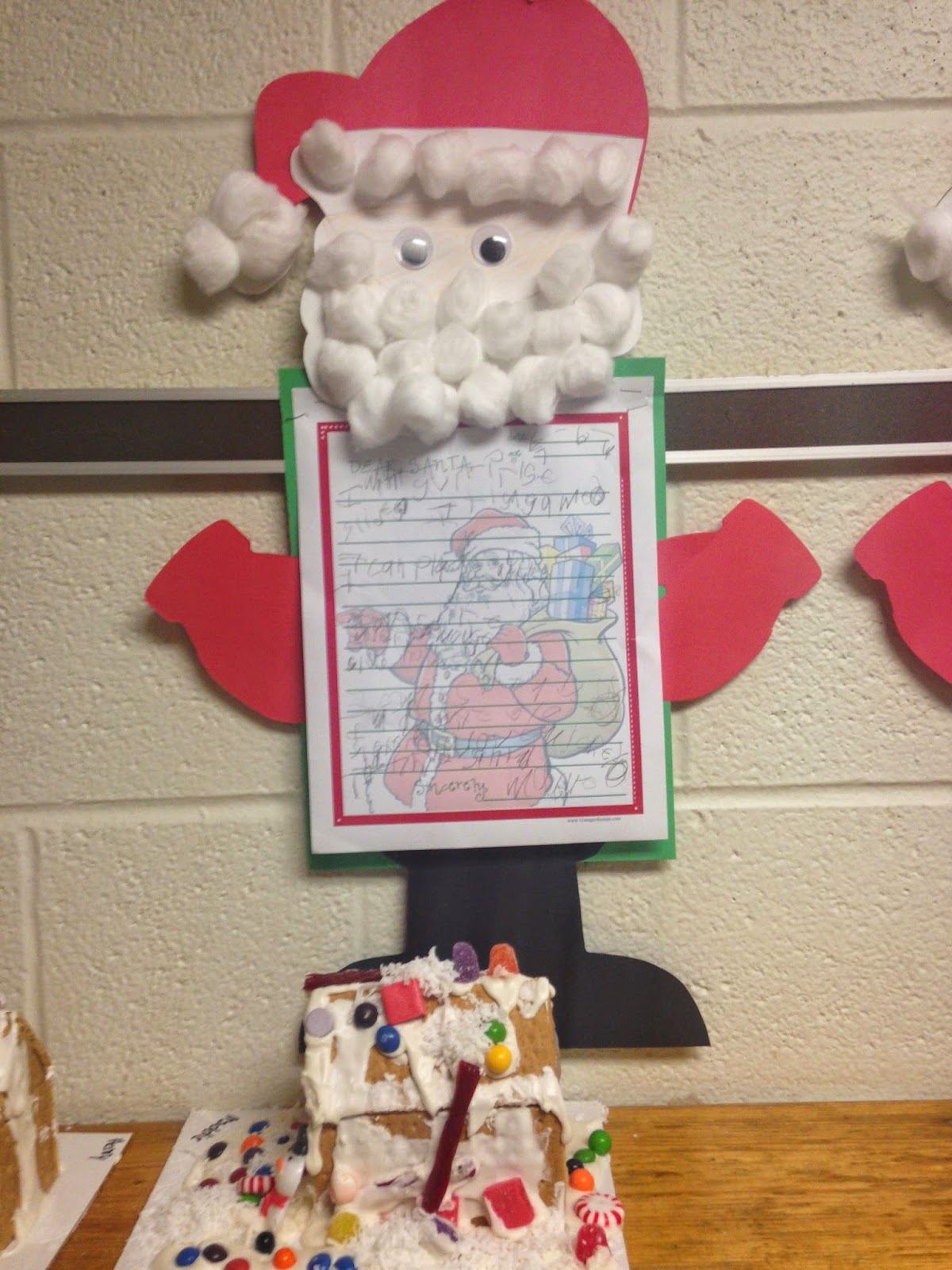
Dear Santa- Winter Handwriting Activity

I will be the first to admit that teaching handwriting is not my strong point.  I've often used the excuse that my students with Autism don't like to write, so we do what we must and get by; it's a technology world anyway.  Don't get me wrong, I do understand the importance of teaching our students with Autism to write, but was this something that you learned in school or just in passing conversation with the OT?

I have, however,  made it my professional goal to find ways to make writing meaningful for my students and to incorporate more writing activities into my students week.  It did not start out with a big project, it started very small, as a transition activity after lunch.  Each student now has a writing binder in which they answer a simple question or fill in the blank and then add a picture.  Now after a few weeks of getting my students desensitized to this, I expanded with this project.


We started with our pre-writing using the basics of Expanding Expression.  My students are familiar with Expanding Expression; we often use it during Language Arts instruction (more blog posts to follow about that).  A few of my kiddos already knew what they wanted for Christmas and were able to verbalize this to us; for those kiddos we found it online, to confirm it is what they wanted, and then printed a picture of the toy so we could help if they ran into difficulty.  For my kiddos that were not able to verbalize what they wanted we pulled out the Toys R Us catalog and went from there.

We did not do all of our pre-writing in one day, it took a few days to complete. Green=Group; Blue=What does it do?; White=What does it look like?; Brown=What is it made of?; White (with triangle)=Where do you get it?; Pink=Details-Why should Santa bring it?; Orange=Anything else/Thank you.

Here is a sample of what it looked like.


Over the next few days we worked on the final product.  The kiddos really seemed to enjoy this product and one student has even wrote another letter to Santa which we have mailed to the North Pole!  I had the Santa paper in a folder, but I'm sure I found it online somewhere.  I also hand made the Santa parts, except the mittens; click here for the sketch: SANTA

And the final product.....


Tuesday, October 7, 2014

Welcome Back

Welcome back everyone!  This year brings yet another change...I've said good-bye to the building that I have taught at since my first day of teaching, I am now at a new building, teaching first grade Autism and Severe Behavior/ED!  I have actually been back to teaching, but I feel as if I haven't been able to catch my breath.  Now; however, we are making it work and it is getting easier day by day.  Working with 3 new aides and a student teacher, a first and third year general education teacher and a new principal...WOW!

Here is what has helped me survive....
Schedules for EVERYONE! XCEL spreadsheets for adults and Visual Schedules for the kiddos!

Constant Lesson Plans!  Why do I feel like have never lesson-planned to this level before, but at least it helps to keep my head above water! 

CAPS Reports - Comprehensive Autism Planning System

These are a life saver, not only for the staff working with the students, but for the parents to understand what and how their children are learning.  These are great for your parents whose needs are difficult to meet.  The CAPS reports addresses 9 areas: Activity, When it is taught, Target Skills to Teach, Structures and Modifications, Reinforcement, Sensory Activities, Communication/Social Skills, Data Collection, Skill Generalization.  In years past I have used the daily CAPS report; a CAPS report is completed for each day of the week for each student (I try to update each of these once a quarter).  This year I am using the CAPS report by activity; a CAPS report is completed for each student, activities are listed and days the activities are addressed are then highlighted.  The paraprofessionals are able to cross-reference the daily schedule with each students' CAPS report.

Click here to download the CAPS report by activity.


Click here to download the daily CAPS report.


Also, don't forget to check out my TpT store for a new math fact fluency product for addition and subtraction.  The packet includes fluency tests, data sheets, file folders, worksheets and "I can" badges!


Friday, November 9, 2012

Let's Talk iPads

Thank you Steve Jobs!  I love your products for both personal and professional use!

iPads and Autism
The use of iPads in the autism classroom are endless and incredibly beneficial.  iPads can provide students with a visual schedule, augmentative communication device, choice board, token economy system, and a teaching/learning tool.  iPads provide the opportunity for visual supports and video modeling; an intervention that is very effective for students with Autism. 

Click here for the 60 Minutes special: Apps for Autism

In my current K-1 classroom each student is fortunate to have their own indivdual iPad for the first half of the day (when I am in the building); the second half of the day, two of the iPads go with me to my PK AU classroom.  One student now has her own iPad that is used as an AAC device.  The iPad, paired with the TouchChat app, has proven to be a motivating communication tool for her. 

Another student use the iPad to complete TEACCH tasks, learn newly introduced vocabulary in an ABA format, make choices, and communicate.  The YesNoHD app is wonderful for students in the beginning stages of choice making and communication.  He uses this app to communicate choices, grettings and requests. 


Lately I feel like I have been advocating more than usual for my students.  My preschool position allows me the opportunity to have access to monetary resources that many do not have the luxury to access at the school age level.  In my preschool classroom we have two iPads (1st and 2nd Generation).  The problem I am faced with is that in a year or so my PK classroom will no longer exist.  I have begun to address the necessity of purchasing iPads for the school age Autism Units.  Possibly crossing the line, I commented that each general education classroom has multiple iPads per room; however the special education classrooms have none, unless purchased from a parent.  My comment was that I feel that our students with special needs are be discriminated against, and that they are not being given the same opportunities as our general education students in regards to technology; technology that provides the opportunity to learn and communicate.

So now I fear that I have over-stepped the boundries (did I mention that I stated this to an admin...).  So in order to avoid a professional dilemma, I am on the search for research articles regarding the efficacy of iPads and students with Autism.  If anyone has any research to share it would be greatly appreciated. 

How are you all using the iPads in your special education classrooms?